How it works

Straight answers from your own cards

Is this annual fee worth it?

Each annual-fee card your plan syncs gets a fee verdict: the fee, how much of it is covered by the rewards you earned, the credits you used and the perks it estimates for you, and what that estimate leans on. A card whose transactions it does not have gets no verdict rather than a guess.

Is a credit about to go unused?

On Plus and Pro, the app puts a reminder in your notifications five days before a monthly, quarterly or semi-annual credit resets with part of it unused, and ten days before an annual one, naming the card and the amount still on the table. It covers the credits that post to your statement; wallet loads and portal credits, which no bank feed can see, are not on it.

Which card should I use for this?

Ask by spending category or by store, in the app or in ChatGPT, and the answer is the card in your own wallet whose rewards are worth the most on that purchase, with any cap you have already used this period counted against it. Once it is connected you can ask from the ChatGPT app on your phone too. Claude works the same way today as a custom connector you add yourself.

Real screenshots from real portfolios. Every number - your weighted earning rate, whether each annual fee still pays off, which card to apply for next - traces back to math you can audit in our public catalog. No marketing-speak, no live award searches we can't actually do, no promises we can't keep.

The same engine answers outside the app: connect ChatGPT or Claude to your own wallet and the assistant does the talking while PointBagel does the math, read-only.

01

The earning rate most apps get wrong

Most apps say your Amex Gold earns 4x on groceries. Spend $30,000 a year at U.S. supermarkets and you've blown past the $25,000 cap, so your real weighted rate is 3.5x, not 4x. We track the cap and your actual spend, then show the calculation behind the number instead of repeating the marketing rate.
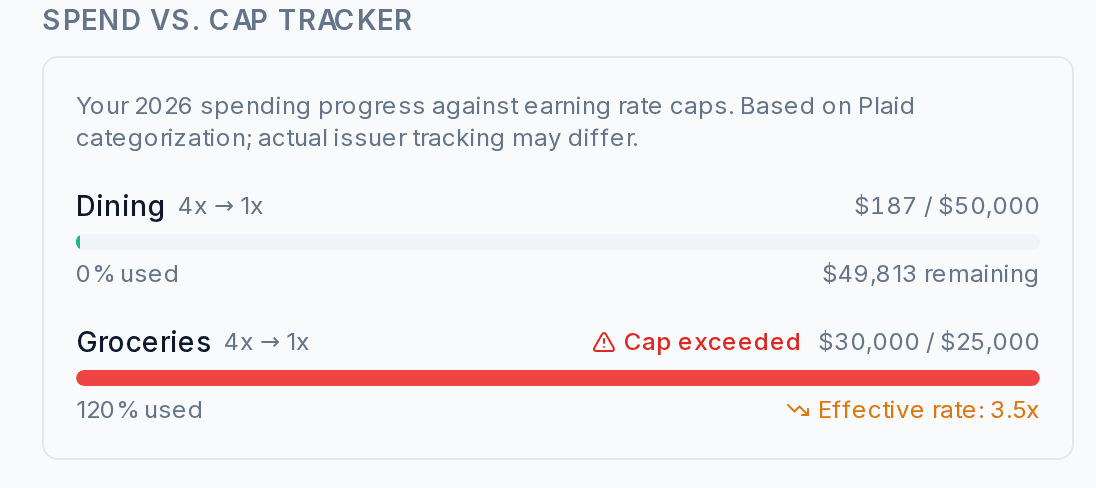
Spend-vs-cap tracker for the Amex Gold groceries category showing $30,000 spent against a $25,000 annual cap, a "Cap exceeded" flag, and an effective earning rate of 3.5x next to the 4x catalog rate.

02

The money your current cards are leaving behind

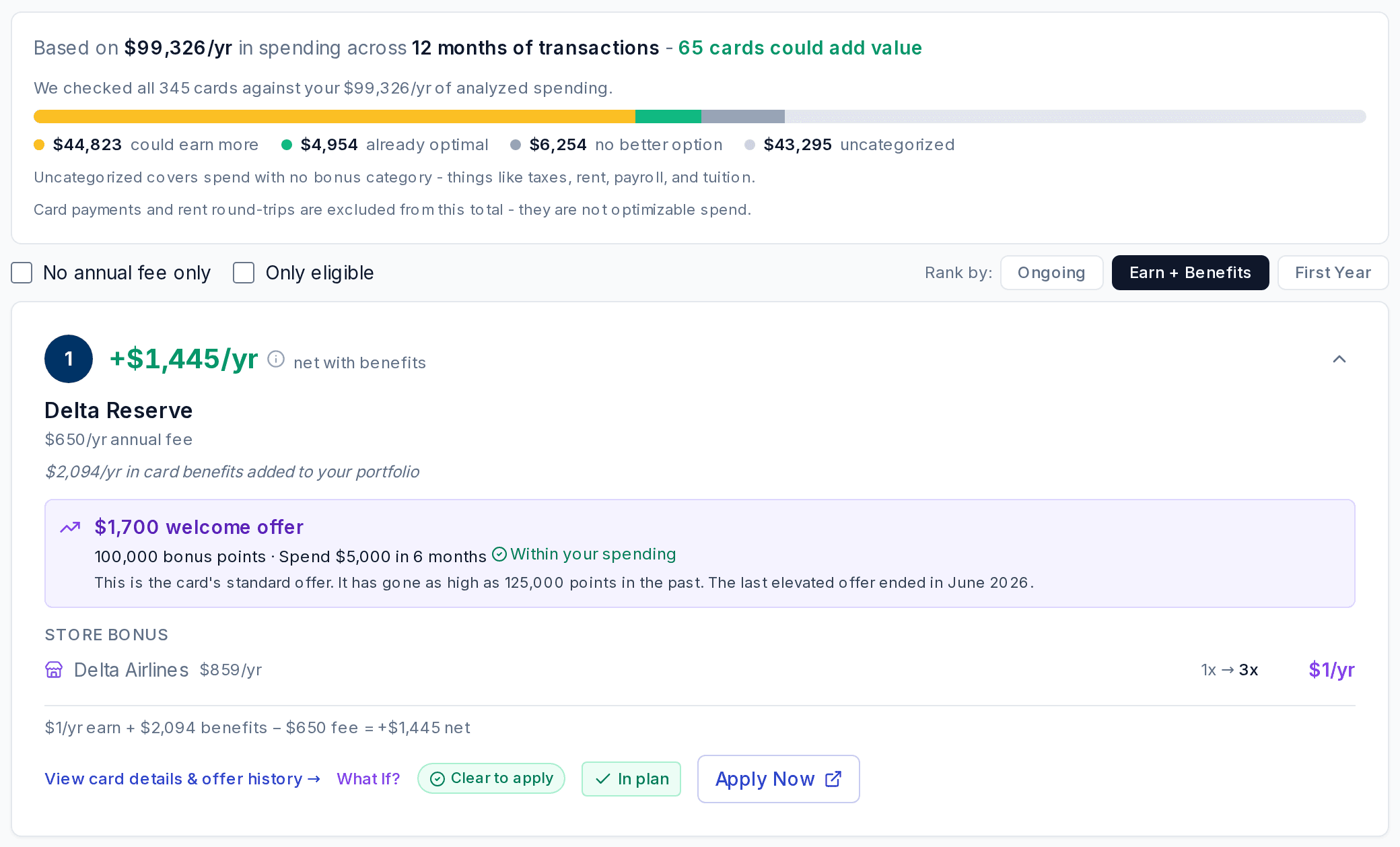
We analyzed $99,326 of your annual spend and found 65 cards that could add value to your portfolio. Your top pick would net an extra $1,445 a year after its fee, and its welcome offer is rated against the card's own history, not a generic "elevated": the view says plainly that today's 100,000 points is the standard offer and that 125,000 was the all-time high. Every recommendation is ranked off your actual transactions and what your spending can realistically hit, so the number is yours, not a national average.

Personalized recommendations view from an August 2026 sample capture: $99,326 in annual spend analyzed, 65 cards that could add value, and a top pick projected at +$1,445 per year net of its fee, with a welcome-offer panel stating that the current 100,000-point offer is the standard one and that 125,000 points was the historical high.

Sample portfolio, screenshot captured August 2026 · the spend total, the card count and the projection above are this demo wallet’s. Yours compute from your own synced transactions.

03

Is each annual fee still worth it?

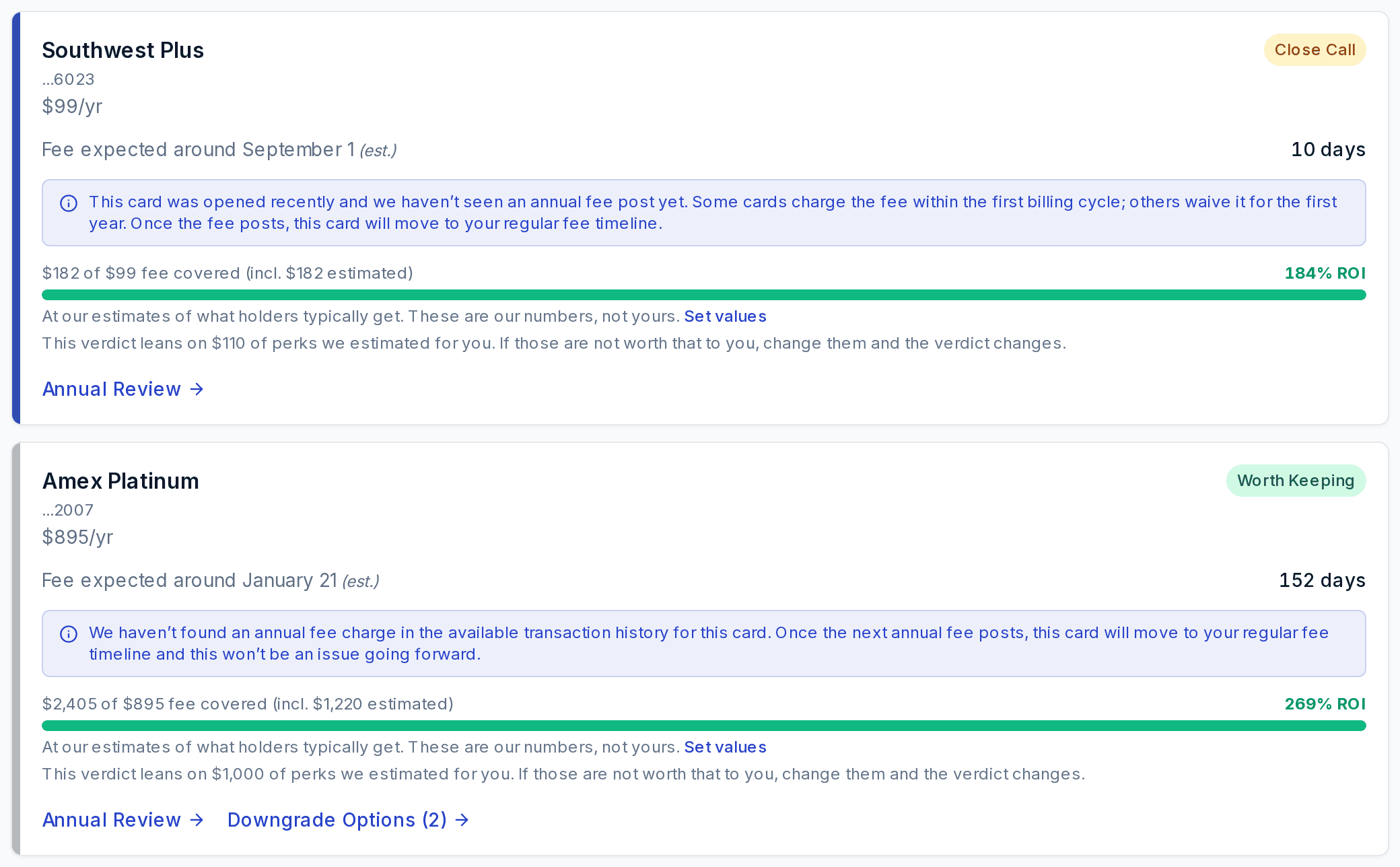
Your Amex Platinum reads "Worth Keeping": at our estimates of what holders typically get, $2,405 of the $895 fee is already covered, a 269% return, and the view spells out what the verdict leans on - change what a perk is worth to you and the verdict changes. A Southwest Plus in the same view gets "Close Call" - its projected value clears the fee, but the card is newly opened and every dollar behind that projection is still an estimate, so the verdict refuses to overcommit. The Platinum's fee rose from $695 to $895 in September 2025, so the math reflects what you actually paid in the card-year you're in, not the latest number applied backward.

Free. The verdict needs that card's transactions synced, without the data we won't pretend to judge the fee. Free auto-syncs 1 card, Plus 5, Pro your whole wallet, so the only step is connecting every card you want a verdict on.

Fee timeline view from an August 2026 sample capture: a Southwest Plus marked "Close Call" with $182 of its $99 fee covered at a 184% return, and an Amex Platinum marked "Worth Keeping" with $2,405 of its $895 fee covered at a 269% return, each card stating the estimated perk values its verdict leans on.

Sample portfolio, screenshot captured August 2026 · the coverage and returns above are this demo wallet’s. The fee history behind them is catalog fact: $695 to $895 in September 2025.

04

Pro

Apply with confidence

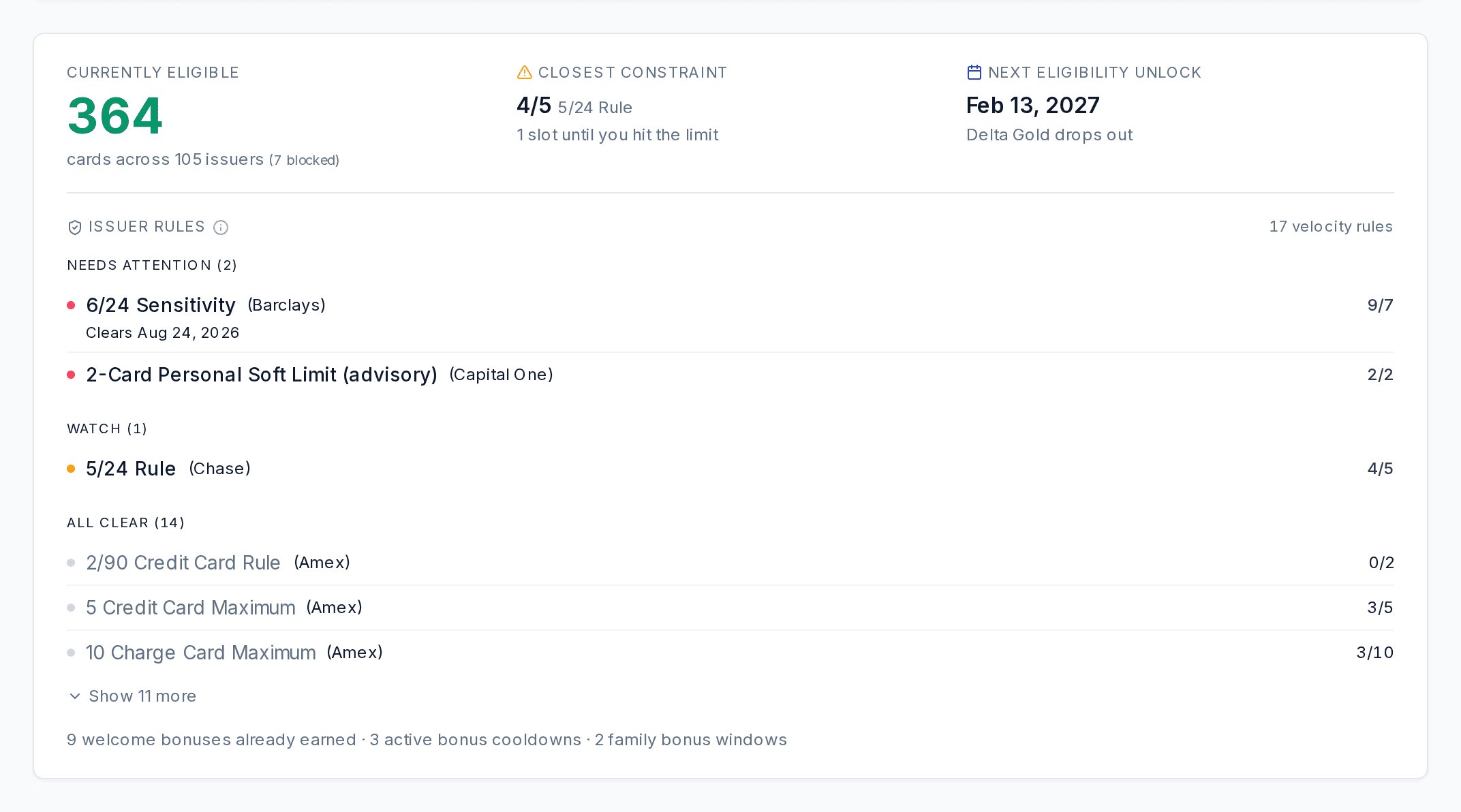
We run 30+ issuer eligibility rules across 14 issuers against your own history - application limits, once-per-lifetime bonus language, and cooldown windows, plus the velocity limits most trackers never check. In the sample portfolio shown here, 364 cards across 105 issuers are open, two issuer rules are flagged as needing attention, and the snapshot names the closest constraint and the next date a slot frees up. It's a guardrail built to keep a hard pull from going to waste, and it flags when an offer is at an all-time high, so you apply when you're both eligible and the bonus is elevated.

Eligibility snapshot from an August 2026 sample capture: 364 currently eligible cards across 105 issuers with 7 blocked, the closest constraint shown as one application-limit slot remaining, a next eligibility unlock of Feb 13, 2027, and an issuer-rules panel tracking 17 velocity rules - two needing attention, one on watch, 14 all clear - with a footer counting 9 welcome bonuses already earned, 3 active bonus cooldowns, and 2 family bonus windows.

Sample portfolio, screenshot captured August 2026 · the 364 open cards and the dates above are this demo wallet’s eligibility. The 30+ issuer rules across 14 issuers are the live catalog.

05

The best home for your points, and when a bonus beats waiting

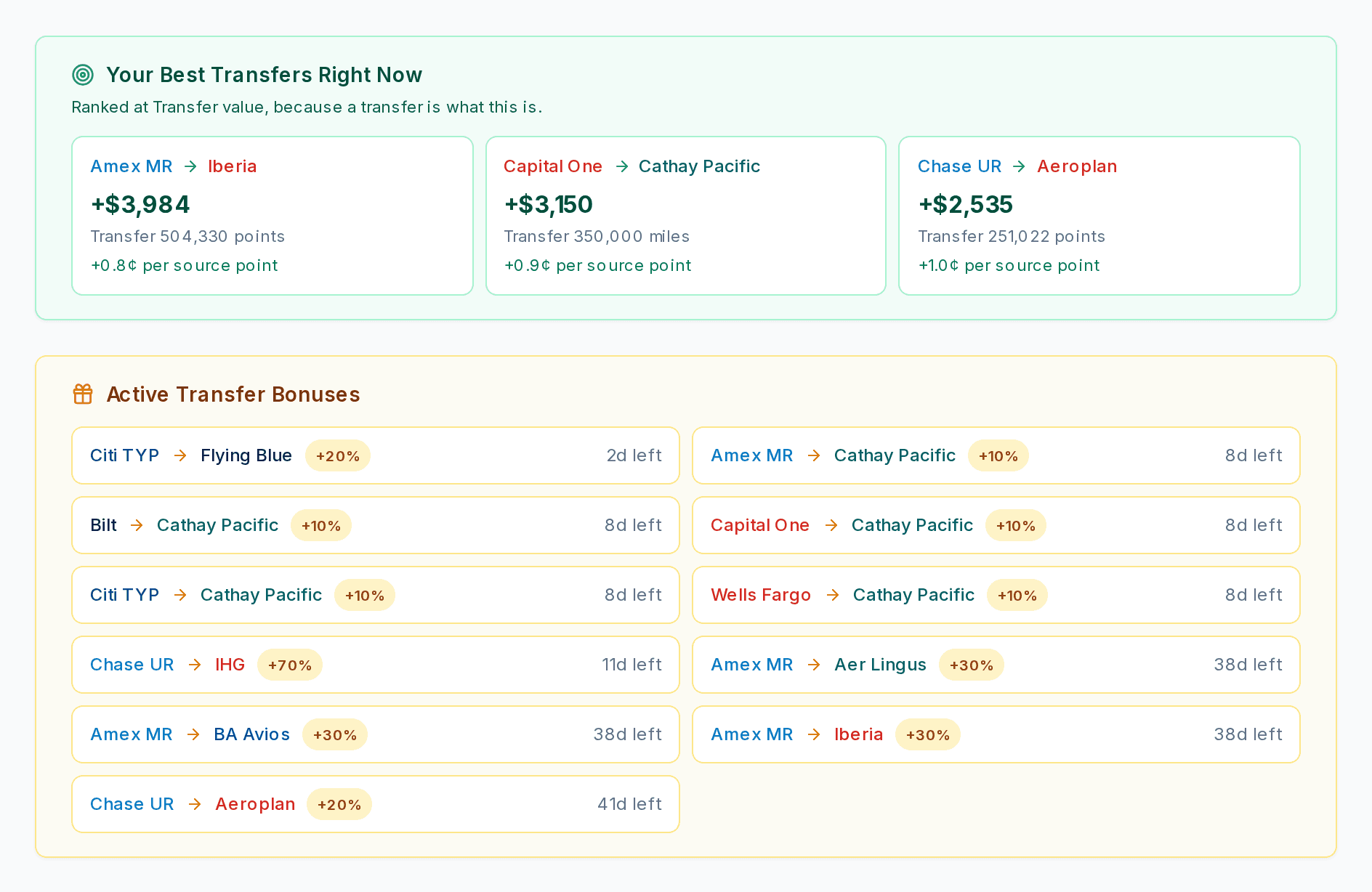
In the sample portfolio shown here, the top transfer is Amex MR to Iberia, worth about +$3,984 over cashing out. Several live transfer bonuses are running too, the biggest being Chase UR to Marriott at +70% and Amex MR to Aer Lingus at +30%. We map 115+ transfer partnerships, each ratio read from the issuer's transfer page where one is public and corroborated across published guides where it is not, with CPP benchmarks per redemption type, then track which bonuses are live, so you can see when transferring beats cash and when one is worth moving on.

Transfer optimization view, a sample captured in August 2026: best transfers listed as Amex Membership Rewards to Iberia at +$3,984 in value, Capital One to Cathay Pacific at +$3,150, and Chase Ultimate Rewards to Aeroplan at +$2,535, plus the transfer bonuses that were running at the time of the capture, including Citi ThankYou Points to Flying Blue and Chase Ultimate Rewards to Aeroplan each at +20%, Chase Ultimate Rewards to IHG at +70%, Amex MR to British Airways Avios, Aer Lingus and Iberia each at +30%, and five programs to Cathay Pacific at +10%.

Sample portfolio, screenshot captured August 2026 · the transfer values above are this demo wallet’s. The live bonuses named in the copy read the current catalog.

What we don't do (and why)

Honest constraints make the rest more credible. Here's where we deliberately stop - and where you'll want a different tool for that job.

We don't search live award space

CPP benchmarks are typical-case math, not "this seat is bookable today." For live award seats, point.me and Seats.aero are better tools - and we link directly to them when relevant. Our optimizer is a guide, not a search engine.

We don't auto-activate card-linked offers

Auto-activation means acting inside your issuer account, which is outside Plaid's read-only model. We have not built that. Today you activate offers yourself (it takes seconds), and your accounts never go out of sync.

We don't promise specific redemptions are bookable

Anyone who's tried to book a 1AM Avianca LifeMiles flight knows the difference between "this transfer is generally a good idea" and "this seat exists right now." We do the first; we link out for the second.

Common questions

Is this annual fee worth it?

Each annual-fee card your plan syncs gets a fee verdict: the fee, how much of it is covered by the rewards you earned, the credits you used and the perks it estimates for you, and what that estimate leans on. The fee-verdict screenshot on this page is that view, and the Free plan includes the verdict on the card it syncs.

Will PointBagel tell me before a credit goes unused?

On Plus and Pro, the app puts a reminder in your notifications five days before a monthly, quarterly or semi-annual credit resets with part of it unused, and ten days before an annual one, naming the card and the amount still on the table. It covers the credits that post to your statement; wallet loads and portal credits, which no bank feed can see, are not on it.

Which card should I use for this purchase?

Ask by spending category or by store, in the app or in ChatGPT, and the answer is the card in your own wallet whose rewards are worth the most on that purchase, with any cap you have already used this period counted against it. Once it is connected you can ask from the ChatGPT app on your phone too. Claude works the same way today as a custom connector you add yourself, and the steps for both are on the AI assistant page.

What do I get on the free plan?

1 card with automatic transaction sync and a fee verdict on it, every other card you hold entered by hand, the full public catalog of point values and transfer paths, and 1 Trip Plan a month. Plus and Pro add more synced cards, the credit reminders and more Trip Plans; the plans are on the pricing page.

Who makes PointBagel?

PointBagel is independent and founder-built: the founder holds the cards, designed the product and the engine behind every number, checks the data against the issuers' pages where they publish one, answers support, and uses it on those same cards every day.

How accurate is it?

We verify every ratio, award chart, and earning rule we cite, and when a value changes we date the change, so a past period keeps the value that was true then. Point values are estimates, labeled as estimates. How we source and maintain each number is on the methodology page.

Ready to see your own numbers?

Free membership: 1 card with auto-sync, a fee verdict on it, unlimited manual cards. No credit card required.