
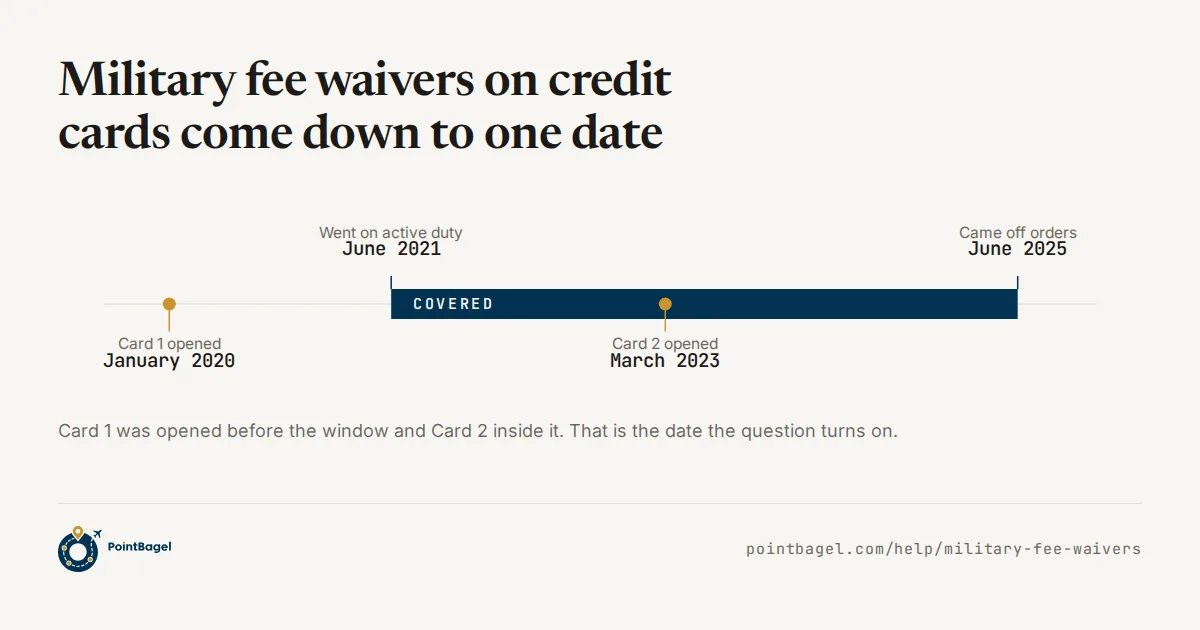
Some banks lower a card's annual fee to $0 for a servicemember, under the Servicemembers Civil Relief Act (SCRA) or the Military Lending Act (MLA). Whether either law applies to a card depends on specific dates: the day that account was opened, and the days the holder was covered, which for most people means the days on active duty or on qualifying orders. Those dates set the coverage terms.
The SCRA can bring down the annual fee on a card you already had before you went on active duty. The MLA covers an account you opened while you were already on active duty. So what decides it is the card's open date against the day your service started: opened before, an SCRA question; opened after, an MLA question.
What the bank can check later, and what it cannot
The rule below tells banks that once an account exists, they cannot ask the federal MLA database whether you were covered on the day you opened it:
At any time after a consumer has entered into a transaction or established an account involving an extension of credit, a creditor (including an assignee) may not, directly or indirectly, obtain any information from any database maintained by the Department to ascertain whether a consumer had been a covered borrower as of the date of that transaction or as of the date that account was established.
That is 32 CFR 232.5(b)(2)(i)(B). The paragraph's own heading is "Historic lookback prohibited."
The lookup site does not fill that gap. A bank can search mla.dmdc.osd.mil to see whether you are covered today, and that is all it hands back. Its own user guide says so: "NOTE: Historical information is not available through this website."
Later on, no one can check what your status was on the day you opened the account. Under the MLA rule the bank is not allowed to go back and look it up, and the government's lookup site shows today's status and nothing else. So the date you went on active duty has to come from you, written down at the time.
Why the answer can differ from card to card
Because the two laws use different dates, two cards in the same wallet can get different answers, so one setting for the whole wallet cannot answer for both, and the record has to be kept card by card.
Coverage also ends. The SCRA defines a period of military service as starting the day a servicemember enters service and ending the day they are released (50 U.S.C. 3911(3)), so coverage has a start and an end, not a permanent status. Someone in the Guard or Reserve can go on qualifying orders, come off them, and go back on later, so dates hold up where a yes or no about a person does not.
What we record, and what we do not say
PointBagel records a military fee waiver one card at a time, with the month it started and, if it has ended, the month it ended. It is not one switch for a whole wallet: the dates differ from card to card, and the record has to be a date.
We looked for the published military policy of the card issuers in our table and wrote down what we could read in each bank's own words. We could not confirm all of them. A bank we could not confirm stays unconfirmed: we make no suggestion on its cards and publish no policy we could not read. If your bank gave you a waiver on such a card, you can still record it yourself.
If your bank charges the annual fee on a card you told us is waived (and we don't see a fee reversal), we show the charge, not the $0 you entered.
A card with a waived fee still shows what the fee would be, and that number stays in the math, so you see what each card is worth before anything changes, not in the month it does.
None of this decides whether you qualify. Your bank decides that, it can decide differently later, and nothing here is legal advice.
The day we checked other tools
On September 11, 2026 we read the public documentation and settings of the other points and card tools we could find. As far as we could read, none of them recorded a military fee waiver per card as a dated window that day. That is what those products documented on one day, not what any of them could build, and we expect it to stop being true.
What to write down
Do this whether or not you use PointBagel. Write down the month you went on active duty or on orders, the month it ended if it has, and the open date of each card you were carrying on either side of that line. Keep them somewhere you will still have them in five years: the same folder as your orders, a notes app, or a text file with a boring name.
It takes a minute now. Piece it together later, in the month a fee posts, and you are working from a bank that is not allowed to look and a database that does not keep the answer.
If you already use PointBagel, tell us once in your military fee waiver settings and we will offer to mark the cards it applies to. Nothing changes until you confirm it, and you can undo it later. The longer version, including what it does not tell you, is on our military fee waivers page.
